All published people · Interactive People search
Avro/Orenda Pilot
Biography
Mike Cooper-Slipper
THOMAS PAUL MICHAEL COOPER-SLIPPER D.F .C. Passed away peacefully at Royal Jubilee Hospital in Victoria, B.C. in the early hours of Monday, February 23, 2004. With him and comforting him at his bedside were his beloved wife Rita and his adoring grand daughter Jessica and her companion Justin. Thomas Paul Michael (Mike) Cooper-Slipper was born in the West Midlands village of Kinver, Staffordshire, the first of three children to Thomas and Catherine on January 11, 1921. Following completion of Grammar School, Mike pursued his passion for flight and joined the Royal Air Force in 1938. Until his release from the R.A.F . in 1946 with the rank of Squadron Leader, Mike served in three theatres of combat. The United Kingdom, Singapore and North Africa and distinguished himself as a fighter pilot, an instructor pilot and a test pilot. In 1940, a young Mike was awarded the Distinguished Flying Cross for valor during the Battle of Britain.
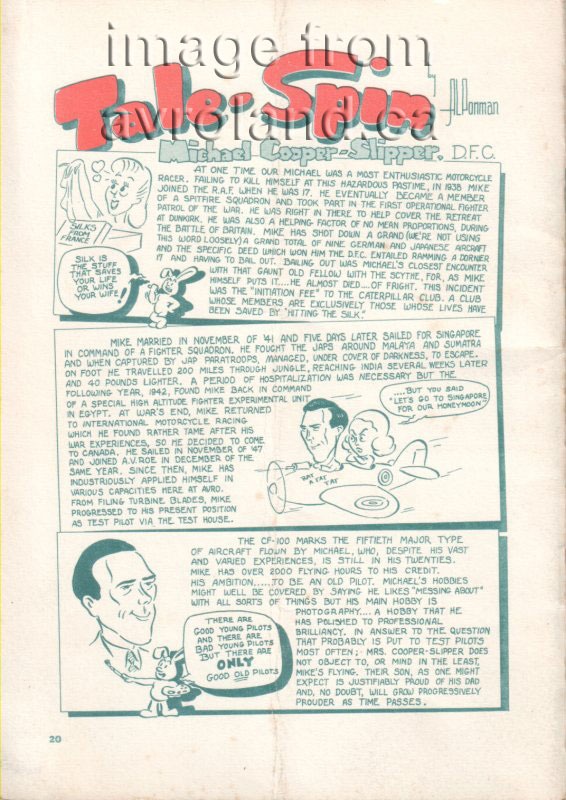
At just 19 years of age he was one of the youngest ever of Winston Churchill's 'Famous Few' to be awarded the D.F.C. In 1947, Mike immigrated to Canada and joined AVRO Canada at Malton, Ontario as an engine fitter. Not long after, Mike became the first post war test pilot hired by AVRO's fledgling Flight Test Department. Mike was assigned flight test duties on the Lancaster Jet Engine test bed, the CF-102 AVRO Jetliner, the AVRO CF-100 all weather fighter and the Orenda powered Canadair F-86 Sabre. During this period Mike developed an expertise in aircraft engine development and when AVRO's Gas Turbine Division was spun off to form Orenda Engines, Mike became Orenda's Chief Test and Development Pilot in 1955. During production and development of the CF-105 AVRO Arrow, Mike's role was to flight test the Orenda Iroquois engine designed for eventual use in the Arrow. He did this along with his crew in a specially modified B-47 on loan to the R.C.A.F. and AVRO from the U.S. Air Force. Since the Arrow program was cancelled before the Iroquois could be fitted in the 6th production Arrow, Mike had the distinction of being the only test pilot to test the Iroquois engine in flight. Following the Arrow cancellation in 1959, Mike embarked on another career in aviation, this time in Aircraft Sales. Through 1972, Mike worked for a number of firms specializing in aircraft sales and technical marketing including de Havilland and Field Aviation. In 1972 Mike joined the Ontario Ministry of Industry and Trade as an International Industrial Development Officer.
He remained in the Civil Service until his retirement in 1986 and traveled extensively promoting Ontario's aviation manufacturing capabilities and was instrumental in creating the Ontario Aviation Consortium. Mike and Rita then retired to Victoria, B.C. where he spent 18 wonderful years pursuing his passionate love of cameras and photography, his interest in aviation history and 'tinkering' with his prized vintage Alfa Romeo.
In 2003, in recognition of a life's contribution to aviation, Mike was inducted into Canada's Aviation Hall of Fame at a ceremony in Halifax, N.S. commemorating the Centenary of Powered Flight. Mike is survived by his beloved wife Rita of 63 years of Victoria, his devoted and proud son Chris and daughter in law Pat of Toronto, his only and cherished grand daughter Jessica of Toronto, his sister Mary of Wales and countless friends and admirers around the world. A service in commemoration of Mike's life will be held on Tuesday, March 2, 2004 at 2 p.m. at First Memorial Chapel, 4725 Falaise Dr., Victoria, B.C. The family wishes to express their sincere gratitude to Dr. Walter Chow, The Reverend John Macquarrie and the very caring staff of 2 West, Royal Jubilee Hospital, Victoria. If so desired, a memorial tribute in Mike Cooper-Slipper's name may be made to The British Columbia Aviation Museum Society, 1910 Norseman Rd., Sidney, B.C., V8L 5V5.
I have asked Bryan Knight a former co-worker of Mikes to share some memories with us:
At CFE I spent a fair amount of time during work with Mike. He was our regular hack test pilot, and I flew quite a lot of the engine and ancillary system test flights with him during some of our routine development programmes ... mostly on Mosquitos ... he and I both survived a crash or two. Mike had a thing about never flying on Saturdays .... He much preferred to be heading for London and the bright lights I guess. So, if scheduled for a Saturday test, he would always arrive early, get in whatever the plane happened to be, and then decline to fly on the grounds that the engine(s) had excessive mag drop on run-up.
(He later told me that he would momentarily blip the second mag switch while testing the "first").
Later, at Avro Canada, I found myself doing the CF-100 weight and balance test set-ups for Mike when we were both on the production night shift ... and under the 'old pals league' rules made quite a few unofficial flights with him in the other seat.
Read The Modest Hero by Don Kerley
Mike Cooper-Slipper, DFC. 1921-2004
The Modest Hero
by Don Kerley
On 23 February, Mike Cooper-Slipper passed way at Royal Jubilee Hospital.
He is survived by his wife, Rita, son, Chris, and granddaughter Jessica.
Mike joined the RAF in 1938 at the tender age 17 1/2 years and trained as a fighter pilot on Hurricanes and Spitfires. He was the youngest pilot in their Squadron. Most of the other pilots had belonged to peacetime reserve units and were several years his senior. In May 1940, they had their baptism of fire in the Battle of France when RAF fighters went up against the more experienced Luftwaffe pilots, veterans of the Spanish civil war. The British Army was being pushed back to beaches near Dunkirk and France was dying. Mike's Squadron was engaged in deadly combat on every mission and suffered heavy casualties. After about a week of heavy fighting the Squadron was withdrawn and sent to Drem, near Edinburgh, to reform and train replacements.
Air Chief Marshal Sir Hugh Dowding knew the Battle of France was a lost cause and wanted to save his pilots and their machines for the coming Battle of Britain. Mike's Squadron lost half of their pilots and most of their Hurricanes were badly shot up. Mike's Hurricane had 75 bullet holes in it as he flew north to Scotland. Mike survived these battles and had several narrow escapes but he had destroyed a Heinkle 111, a Junkers 87 and a Junkers 88. On the way to Scotland they spent a night a Shawbury, Shropshire, and they got a kick out of showing their battle damage to the student airmen there. That summer of 1940 seemed so unreal to Mike. People in the rest of the United Kingdom were carrying on the their usual peaceful pursuits while, in that little area of the South Coast and parts of France and Belgium, thousands were dying in desperate battles. Churchill warned the British people and the world "The Battle of France is over. The Battle of Britain in about to begin. On this battle depends the survival of Christian civilization. The whole fury and might of the enemy must very soon be turned upon us. Hitler knows he must break us in this island or lose the war. Let us therefore brace ourselves to our duties, and so bear ourselves that if the British Empire and its Commonwealth last for a thousand years, men will say, "This was their finest hour"
In September 1940 the 605 Squadron moved from Drem to Croydon, south of London, and Mike, still a teenager became one of "the few" taking part in this epic struggle. He acquitted himself very well bringing down two Me 109s, three Do 17s, as well a sharing in the destruction of several others. There were two or three incidents during this time that is worthy of mention. The first one s a visit to the Squadron, at Croydon, by Winston Churchill, during the height of
the battle. Churchill spotted this young, handsome, pilot and made a point of talking to him Mike took advantage of the occasion and got the 'great man' to sign his log book.
The second incident saw Mike chasing an enemy bomber racing for the Channel. In an attempt to increase its speed the bomber jettisoned its bomb load on the houses and fields in the local area. A few days later Mike attended a social event where he over-heard an beautiful young lady telling friends about being nearly killed by bombs dropped from a bomber being chased by a Hurricane. Mike introduced himself as the pilot of the Hurricane. The girl was Rita, who later became Mike's wife.
The third event happened on September 15 when Mike's Hurricane became embedded in the tail of a Dornier 17. Was this the action of a rash young pilot, out of ammunition, but determined to bring down the enemy, or was it an accident of overtaking the target at too high a speed and getting tossed about in the bomber's slipstream? Take your pick! Mike parachuted to safety, landing in the Thames estuary. In November he was awarded the DFC. On September 15, celebrated ever since as Battle of Britain Day, the RAF and the Luftwaffe fought one of the war's decisive battles. In a daylight attack some two hundred bombers crossed the Channel escorted by a larger number of fighters. The RAF was ready and intercepted them before they reached London, shooting down many of them and dispersing the rest. In the afternoon the Luftwaffe returned in even greater strength and was again routed. In the evening RAF Bomber Command raided the enemy invasion fleet in the Channel ports inflicting heavy damage. Two days later, Hitler postponed the invasion of Britain and the Luftwaffe switched to night bombing raids.
In the next few months, Mike took an instructor's course and became a Flight Commander at the Naval Flying School. In July 1941 he was posted to 96 Night Fighter Squadron flying Defiants. In October 1941 he became Commanding Officer of 135 Squadron, a Hurricane Squadron, especially modified for operations from cold airfields in Russia. When Japan entered the war in December, his ship, loaded with the winterized Hurricanes, was diverted to Singapore. By the time they reached Singapore the area was under attack by the Japanese. When Singapore fell Mike took his airmen and most of the pilots to the dock area where the caught a boat to Sumatra. While there he managed to make two Hurricane sorties. In one of them he downed three bombers. The three were in formation and Mike fired at the middle one, which exploded taking down the other two as well. The next several months were the most arduous and most dangerous period of Mike's life.
Japanese paratroopers captured their airfield and Mike was taken prisoner. As darkness fell Mike escaped down the road to Palembang where he crossed the river and joined a group of about twenty men and four nurses trying to reach the coast through the jungle. It was a terrible ordeal and only four of them made it to the coast where a freighter took them to Batavia (now Jakarta} in Java. A bomb exploded next to Mike's slit trench producing a concussion, which resulted in him being put on a hospital ship bound for Colombo. It wasn't really a ship, it was a Chinese river boat but the Japanese Navy gave it safe passage. He eventually arrived in India where he was treated for a fractured skull and malaria at a hospital in Poona. His weight was down to 100 pounds and he was the only one of his Squadron to reach India. After three months he was transferred to a convalescent hospital in Pietermaritzburg, South Africa, where, under skilled care, he gradually recovered.
While in a transit camp in Cairo, Mike met an old acquaintance who asked him to help solve a problem. He wanted to stop a high-flying Junkers 86 from taking photographs from an altitude of 40,000 feet. The Engineering Department reduced the weight of a Spitfire IX and geared up the blower on the supercharger, which permitted Mike to fire on the intruder at 43,200 feet. The continuous high altitude flight caused Mike's health to break down again and he was restricted to flying no higher than 10,000 feet. In November 1944, after a absence of three years, Mike returned to England and to Rita, his young bride. He worked as a test pilot until he resigned from the RAF in 1946.
After he immigrated to Canada he began another distinguished career in aviation. He worked as a test pilot for Avro Canada and in June 1955 he became Chief Test Pilot for Orenda Engines Ltd. There he was involved in the development of engines for the CF 100 and the F86 Sabre, and on the Iroquois engine designed for use in the Avro Arrow. After the Arrow project was cancelled he worked for De Havilland for five years and for Field Aviation for five years. He also worked for the Government of Ontario prior to retiring to BC in 1986
In retirement Mike enjoyed a well-earned respite from an active life, filled with excitement, danger, and adventure. He and Rita adapted quickly to the laid-back atmosphere of Victoria and Mike continued his passion for photography, and watching auto-racing on the TV and tinkering with his vintage Alfa-Romeo. He was warmly welcomed as a member of the Vancouver Island Branch of the Aircrew Association and the members of this group are very proud to have such a fine gentleman as one of them. For us he was our one solid link to that moment of history when Britain and the Commonwealth had their Finest Hour.
Mike Cooper Slipper, DFC: born 11 Jan 1921 started at A.V. Roe Canada in 1947, filing jet blades for the Chinook at $2.50 an hour. Flew as test pilot on the CF-100 and Lancaster test bed for Orenda engines, test pilot on B-47 with Iroquois - Mike left us 23 February 2004 - read more.......
Affiliations
- AVRO
Historical links and further information
- Existing group information
- Original biography / historical content
- Bryan Knight
- The Modest Hero
- Original biography / historical content
- Original biography / historical content
Photographs